A Two-Way Door Decision Template for Teams

Your team has discussed the same decision three times. Someone says it's a two-way door. Someone else wants more information. Another meeting goes into the calendar.
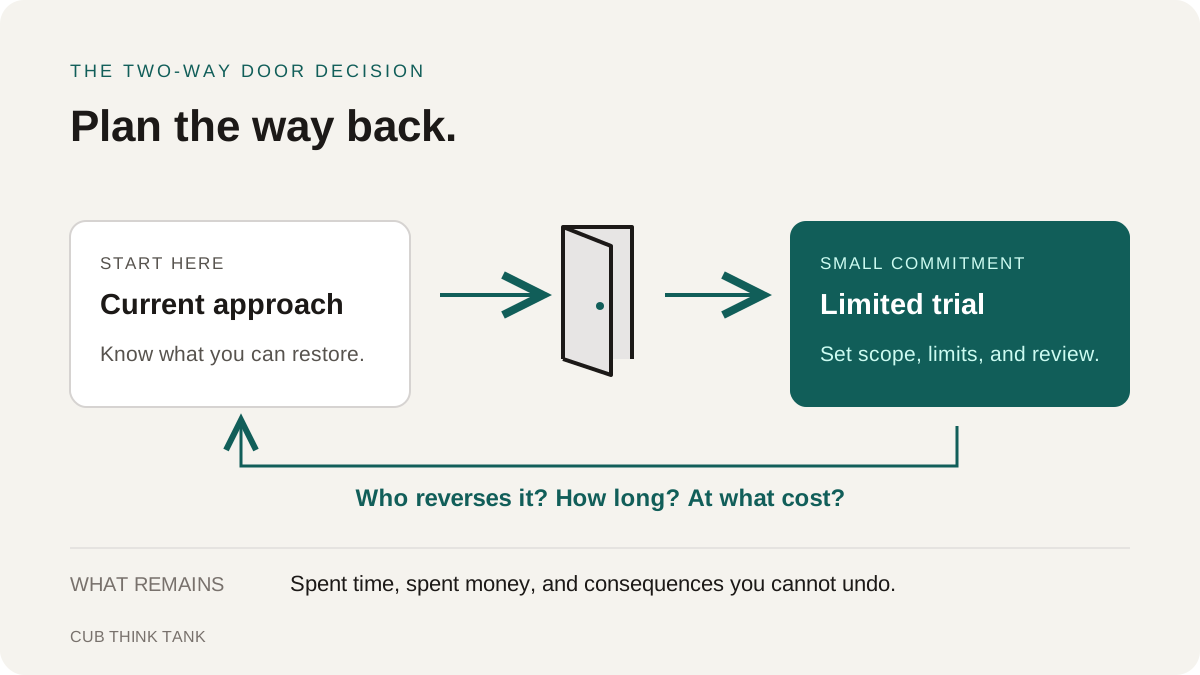
Before the next discussion, write down how you would reverse the decision. Who would do it? How long would it take? What would you lose even if you went back?
Those answers make the conversation more useful. This two-way door decision template helps your team define a small commitment, name the person who can decide, and agree when to review it.
Go to the template or see how it works.
What is a two-way door decision?
A two-way door decision is a choice you can reverse without unacceptable lasting consequences. A one-way door decision is irreversible, or difficult enough to reverse that it deserves more deliberate consideration. Amazon also calls these Type 2 and Type 1 decisions respectively.
In his 2015 shareholder letter, Jeff Bezos argued that reversible decisions can be made quickly by people with good judgment or small groups. As organisations grow, they tend to apply a heavy decision process to these choices too. That slows experimentation.
The distinction helps you choose how much deliberation a decision deserves. It doesn't tell you whether the idea itself is good.
For the full explanation, read one-way versus two-way door decisions. The rest of this page is about putting the idea to work.
Copy the decision template
This is our template, adapted from Amazon's framework. It isn't an official Amazon document. Use it when a decision needs shared understanding; choosing tomorrow's meeting time doesn't need nine fields.
You can fill it in here or copy the blank version into your team document. The completed example below the fields shows the level of detail to aim for.
Your decision, on one page
Fill in the fields, then copy or download your decision. Entries are not saved when you leave or reload this page.
What exactly are we deciding? Include scope and deadline.
Who can decide within these limits? Whose input is needed?
What should improve, and what evidence supports trying it?
What can we try before making a larger commitment?
Set limits on time, money, and who will be affected.
Who will reverse it, how, and how long will that take?
What cannot be recovered or undone?
When will we review? What would make us continue, change, or stop early?
Proceed, reduce scope, investigate an uncertainty, or use a more deliberate process. Why?
Completed example: changing a weekly meeting
A fictional example to illustrate the template, not a reported case study.
- Decision
- Trial a written update and 15-minute discussion instead of our 60-minute weekly internal project meeting.
- Owner and input
- The project lead decides after input from the team. Existing approval responsibilities stay in place.
- Expected benefit
- Recover meeting time without losing track of blockers or decisions. Our last three meetings spent most of their time reading status updates aloud.
- Smallest useful step
- One internal project team, for three weekly cycles.
- Limits
- No changes to customer meetings or required approvals. Keep preparation under 15 minutes per person and record preparation time as well as meeting time.
- Way back
- The project lead restores the original meeting invitation and agenda for the next cycle. Urgent blockers are raised immediately through the existing escalation channel.
- Lasting consequences
- Preparation time is spent either way. A missed deadline or delayed escalation cannot be undone by restoring the meeting.
- Review and stop conditions
- Review after the third cycle. Compare total preparation and meeting time with the previous format, check unresolved blockers and missed decisions, and ask the team what was lost. Stop early if the new format causes an urgent blocker to be missed. Continue only if time is saved without losing necessary coordination.
- Decision and reason
- Proceed with the limited trial. The format is easy to restore, and the team has a way to raise urgent issues between meetings.
Start with the commitment, not the category. “Should we change our pricing?” is too broad. “Should we test this price on one new offer for two weeks?” gives you something you can examine.
If you cannot describe a credible way back, leave the classification open. Reduce the commitment or investigate the uncertainty before treating it as a two-way door.
A worked example changing the weekly meeting
Imagine a team spends an hour each week reading project updates aloud. The project lead proposes replacing that meeting with a written update and a 15-minute discussion. This is a fictional example, not a reported case study.
The initial proposal sounds easy to reverse. You can always put the meeting back. But that isn't the whole decision: what happens if a blocker goes unnoticed while you are trying the new format?
Here's how the team could make the trial concrete:
- Scope: One internal project team, for three weekly cycles. Customer meetings and required approvals continue as before.
- Owner: The project lead makes the decision after getting input from participants.
- Limits: Written updates should take less than 15 minutes per person. Count preparation time as well as meeting time.
- Way back: The project lead restores the previous meeting format for the next cycle. Urgent blockers still go through the existing escalation channel immediately.
- Review: After three cycles, compare total time spent, unresolved blockers, missed decisions, and team feedback.
- Stop condition: Restore the previous format early if an urgent blocker is missed because the new process failed.
These limits are illustrative choices for this team. They aren't rules from Amazon.
The team is testing whether coordination can take less time. Measuring only the shorter meeting would miss extra writing, follow-up messages, or decisions that never get made.
Restoring the meeting also won't undo a missed deadline. The template makes that remaining exposure visible before the trial begins.
How to check the way back
“We can always change it later” is a weak explanation. Use these questions to make it specific.
Can we reverse it or only stop it?
You can stop an advertising campaign. The money already spent remains spent. You can remove a confusing message from your website, but some customers may already have acted on it.
A two-way door doesn't require zero cost. It requires an acceptable commitment and a credible response if the decision goes badly. State what your team is prepared to lose, rather than pretending nothing can be lost.
Can we still go back next month?
A tool trial can grow into a migration. People start depending on it, data accumulates, and other systems become connected. The return path gets harder while nobody is explicitly deciding to make a larger commitment.
Set a review before that happens. Expanding a pilot should be a fresh decision with fresh limits.
Who else bears the consequences?
An internal change may be simple for your team to reverse while causing work for somebody else. Think about customers, support staff, partner teams, and anyone relying on the current arrangement.
Their input can reveal costs the decision owner cannot see. Keep consultation focused on those consequences.
What would make reversal impractical?
Name the obstacle: a long contract, unavailable recovery steps, lost information, or a promise that can't reasonably be withdrawn. One material obstacle can outweigh several easy-to-reverse parts.
I wouldn't add up a numerical score here. A decision can look favourable on eight questions and still be unsuitable for a quick trial because of the ninth.
Three decisions with different commitments
The category depends on the scope. These hypothetical examples show how much that matters.
Trying a project management tool
Broad proposal: Move the whole company to a new platform.
That includes more than a software subscription. It may require moving records, changing integrations, training staff, and retaining access to the old system.
Smaller proposal: Let one team use the tool for a new internal project. Keep existing work where it is, check how to export the trial's records, and review before adding another team.
The smaller version gives you a way to learn without committing everyone. If you cannot retrieve the work in a usable form, resolve that before starting.
Changing a customer onboarding page
Broad proposal: Replace the onboarding journey for every customer.
Smaller proposal: Test revised explanatory copy with a limited group while preserving the previous version and a quick way to restore it. Agree what completion problems or support reports would stop the test.
AWS uses website and app feature testing as an example of a decision with limited, reversible consequences. The limits matter: being able to revert a page doesn't undo a customer's experience.
Our article on the Uber Map Effect offers another way to think about this kind of improvement: what information would make the experience clearer for the customer?
Committing to an office
Broad proposal: Sign a long lease because the team might need more space.
The ongoing commitment makes “we can leave if it doesn't work” an incomplete answer.
Smaller proposal: Where available, try a short arrangement to learn about attendance, travel, and working patterns before making the larger commitment.
The trial can inform the later choice. It doesn't make the eventual long-term agreement reversible. Some decisions still deserve a slower process.
Use it with your team
Ask the person proposing the change to prepare a short first pass. The meeting should resolve the disputed assumptions, not compose every sentence together.
Start by agreeing on the exact decision. Then identify what would be difficult to undo. If one person thinks reversal takes an afternoon and another thinks it takes a month, that is the useful disagreement to investigate.
Make authority explicit. The person maintaining the document may not be the person entitled to decide. Record the owner and the limits within which they can act. Single-threaded leadership is useful further reading on dedicated ownership; completing this template doesn't require reorganising your team around that model.
Invite input from people who understand the consequences. Separate advice from the authority to decide. Pixar's Braintrust is an interesting example of feedback that helps the owner without giving the group control of the work.
Before finishing, record one outcome: proceed, reduce the scope, investigate a named uncertainty, or use a more deliberate process. If more evidence is needed, give someone responsibility for obtaining it. “Let's think about it” doesn't tell the team what changes next.
Review the decision before it becomes permanent
At the review date, return to the expected benefit and the limits you agreed. What happened? What did it cost? Did the return path remain available?
Continue when the evidence supports it. Change or stop when it doesn't. If results are inconclusive, make an explicit choice about whether another bounded trial is worth the cost. Set a new scope and review date instead of quietly extending the old one.
This is where choosing useful input metrics can help. A shorter meeting or more page clicks is only useful if it serves the outcome you actually wanted.
In his 2016 shareholder letter, Bezos connects fast decisions with recognising and correcting mistakes. He also discusses deciding with around 70% of the information you wish you had. Treat that as a prompt to examine delay, not a literal confidence score or permission to ignore a consequential unknown.
Questions teams ask
Is a two-way door decision always low risk?
No. A reversible action can still have significant consequences before you undo it. Examine the exposure during the trial as well as the difficulty of reversal. If that exposure is unacceptable, reduce the scope or take more care.
What if we disagree about the decision type?
Write down what you disagree about. Estimate the recovery work, ask the affected team, or test an assumption at a smaller scale. “Unsure” is an acceptable working answer. It tells you what needs attention.
Do we need a meeting for every template?
No. An owner may be able to collect necessary input in writing and decide within their existing authority. Use a discussion when it will resolve something that written input hasn't.
Can AI help fill it in?
Yes, as a way to surface questions or organise your notes. Our one-door versus two-door AI prompt is a starting point. Check its assumptions about your business, especially reversal costs and decision authority. The decision owner still needs to judge the answers.
Is a reversible decision automatically worth trying?
No. You still need a plausible benefit and a reason to spend the team's time. If you haven't established what a proposed product would do for customers, Amazon's working backwards press release technique can help clarify the idea first.
Take one decision your team keeps postponing. Copy the template, describe the smallest useful commitment, and write down how you would go back. Bring those answers to the person who can decide.