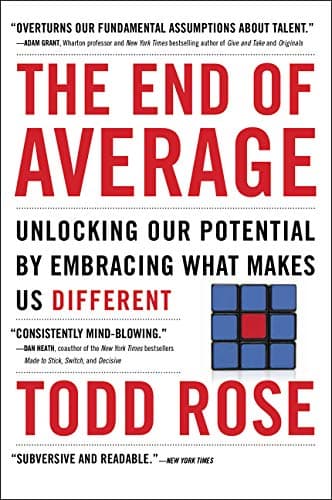
The End of Average by Todd Rose
Why this book is worth reading
The best idea in this book is this: averages are useful for systems and dangerous for people.
That sounds obvious until you start noticing how often we flatten people into one number.
- GPA
- Performance rating
- IQ
- Personality type
- Engagement score
- Health benchmark
The number makes the person easier to manage, but what I found interesting about this book is that the person who invented averages in education, had an agenda.
You see they didn't actually believe that people could get better, so they wanted to identify outliers and their theory was that all energy should be focused on them. It's actually quite bizzare that education dates back to this.
He starts with an interesting story about airline pilots.
In the 1940s and 1950s, pilots were struggling in cockpits designed around average body measurements. The answer seemed obvious: get better averages. Measure more pilots. Update the cockpit around the average pilot.
But when researchers looked at thousands of pilots across multiple body dimensions, the average pilot basically disappeared. A person might be average in height but not in arm length, chest size, leg length, or shoulder width. Designing for the average meant designing for almost no one.
This is the central premise of the book, we think there are so many 'average paths for everything' and we design for the average person who basically doesn't exist.
I liked this book because it gives language to something you can feel in real life. The average customer does not exist. The average employee does not exist. The average student does not exist. The average user does not exist. Yet we keep designing schools, jobs, products, career paths, and performance systems as if they do.
The jaggedness principle
Rose's strongest framework is jaggedness.
Some things are one-dimensional. Height is close enough. You can line people up from shorter to taller and the ranking mostly makes sense.
But talent is not like height.
Someone can be brilliant verbally and ordinary spatially. A person can be exceptional with customers and weak at internal politics. A developer can be superb at debugging and slow at architecture. A student can be great at reasoning and terrible at timed tests.
The trap is compressing that jagged profile into one number and then acting like the number explains the person.
This is the part that matters for hiring and leadership. If you ask "is this person good?" you are already losing detail. Better questions are:
- Good at what?
- In what environment?
- With what constraints?
- Paired with which people?
- Measured over what time horizon?
That is slower than a score. It is also much closer to reality.
The context principle
The context principle is the one that should make managers nervous.
We love stable labels. Introvert. Extrovert. High performer. Difficult. Strategic. Creative. Detail-oriented. Not a team player.
Some labels are useful shorthand. The problem is when we forget they are shorthand.
People are not equally themselves in every environment. Someone can be quiet in a hostile meeting and persuasive in a trusted room. Someone can look disorganised in a chaotic team and become excellent inside a clearer system. Someone can be "not leadership material" under one boss and obviously leadership material under another.
That does not mean people have no character. It means behaviour is often an interaction between person and situation.
This is a useful corrective for performance reviews. When someone struggles, the lazy interpretation is "they are underperforming." Sometimes that is true. But the better question is:
What is the if-then pattern?
If the work is ambiguous, then they freeze. If the customer is angry, then they become calm. If the deadline is fake, then they drift. If the team is small, then they lead. If the team is political, then they withdraw.
That is much more useful than a personality label.
The pathways principle
If people have jagged profiles and context-sensitive behaviour, then one standard route will waste talent. A school that rewards only one pace will misread students. A hiring process that filters by one credential will miss capable people. A career ladder that only has one sequence will select for conformity as much as competence.
So his key question is this:
What evidence of mastery actually matters, and how many ways can someone show it?
This is where the book feels relevant beyond education. It applies to software onboarding, sales training, internal promotion, product adoption, recruitment, and customer success.
If the only way to prove competence is to survive your preferred maze, do not be surprised when you mostly find people who are good at mazes.
All in all it was a great book and it definitely makes you reconsider something that you have always taken for granted. That averages were actually invented by someone and that humans are more unique and special than we give them credit for.
As an Amazon Associate I earn from qualifying purchases.