The Almanack of Naval Ravikant
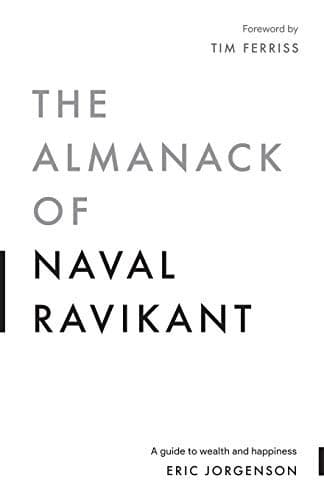
Read the official free version or view it on Amazon.
Why this one is a 6/10
I liked the start of this book much more than the end.
The first half has a useful, practical argument: you do not get rewarded for being generally busy. You get rewarded for building specific knowledge, taking accountability, finding leverage, and playing games where your judgment compounds.
That is a good model. It feels especially relevant if you are building a company, choosing a career path, or trying to stop copying the default script.
The later happiness and philosophy sections did less for me. Some of it is true. Some of it is familiar. Some of it reads like a collection of polished lines that work better as tweets than as a book chapter. I do not mean that as a cheap shot. The book is literally curated from Naval's interviews, tweets, and reflections, so the format is part of the deal.
So my take is simple: read it for the wealth and agency frameworks. Skim more aggressively when it turns into life philosophy.
The strongest idea: follow your own path
The part I liked most is the push toward work that fits you.
Naval's version is not "follow your passion" in the vague motivational poster sense. It is more useful than that. He is saying that the work you are naturally curious about gives you a strange advantage because you will spend more time with it, notice more, and keep improving when other people get bored.
That matters because specific knowledge is hard to teach from the outside. You can learn accounting, law, React, sales, or strategy from normal routes. But the edge usually comes from the weird overlap: the thing you cannot stop thinking about, mixed with enough skill and enough market demand.
That is a better career question than "what job should I get?"
Ask:
- What do I keep learning without needing discipline?
- Where do I have taste that is hard to explain?
- What feels like play to me but looks like work to others?
- Where could I build judgment that other people would eventually trust?
This is the bit that lasts.
Specific knowledge beats generic ambition
The book's most useful framework is specific knowledge plus accountability plus leverage.
Specific knowledge is the skill or judgment you build by following curiosity and obsession. Accountability is being visibly responsible for outcomes. Leverage is the force multiplier that lets your judgment scale.
The order matters.
Leverage without specific knowledge just amplifies average work. Accountability without leverage can trap you in high-pressure labour. Specific knowledge without accountability can become private cleverness that never gets paid.
Put the three together and you get a much better map for building a career or business.
Leverage is the practical unlock
Naval is good on leverage because he separates old leverage from new leverage.
Old leverage was labour and capital. You needed people working for you, or money working for you. Both still matter, but both usually require permission. Someone has to join you. Someone has to fund you. Someone has to trust you before the flywheel starts.
New leverage is code and media. You can write, publish, record, build, automate, and distribute with much less permission.
That is why this book pairs well with building in public, writing online, software, and small expert businesses. If you have good judgment and can package it in a way other people can use, your work can travel without you being in every room.
The practical question:
What could keep working after I stop working?
That could be a product, an article, a tool, a course, a checklist, a dataset, a small app, or a reputation for unusually good judgment in one narrow area.
Accountability is where most people duck
The accountability section is uncomfortable in a good way.
It is easy to want upside. It is harder to put your name against a decision. Accountability creates personal risk, but it also creates trust. People do not pay for vague effort. They pay when they believe your judgment will make a difference.
For consultants and founders, this is a clean test:
- Are you willing to recommend a path?
- Are you willing to say what you would do?
- Are you willing to be measured by the outcome?
If not, you may be hiding inside process.
The happiness section was weaker for me
The second half is where the book lost energy.
There are useful lines about desire, identity, peace, and awareness, but I did not find the framework as strong. It felt less like a map and more like a stack of wise sentences. Some readers will love that. I wanted more of the sharp operating advice from the first half.
That does not make the happiness section bad. It just makes it less distinctive.
The wealth section gives you a model you can use on Monday. The happiness section gives you reminders. Useful, but easier to get elsewhere.
Cool things worth keeping
The best ideas I would keep:
- Find work where curiosity gives you endurance.
- Build specific knowledge that cannot be easily taught in a classroom.
- Take accountability so your judgment becomes visible.
- Use leverage so good decisions scale.
- Choose long-term games because reputation compounds.
- Avoid status games because they are multiplayer traps with bad scoring systems.
- Improve judgment before adding effort.
The line that probably explains the book's whole appeal is that it gives ambitious people permission to stop copying the obvious path.
That is valuable.
My take
This is not a perfect book, but it is a useful one.
I would not read it cover to cover with equal attention. I would read the first half slowly, mark the career and wealth frameworks, and skim the second half for the occasional line that lands.
The lasting value is not that Naval has every answer. It is that he gives you better questions about work:
What knowledge am I building? Where am I accountable? What leverage am I using? Who am I playing long-term games with?
Those questions are worth the read.
As an Amazon Associate I earn from qualifying purchases.