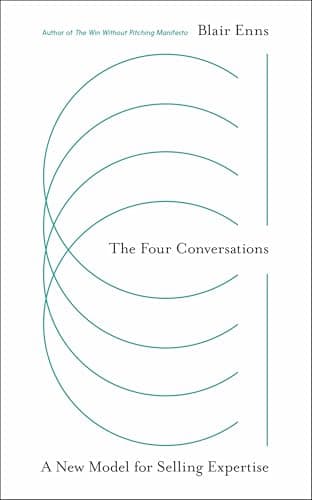
The Four Conversations by Blair Enns
Why this one matters
Most sales books are written for people selling products. That is useful until you sell judgement.
If you run a consultancy, agency, software studio, advisory firm, design practice, or anything else where the work begins before the scope is fully knowable, the normal sales advice starts to wobble. Be enthusiastic. Do a deck. Send the proposal. Prove you want it. Show the client how hard you will work.
Blair Enns is arguing for almost the opposite posture. The sale of expertise should look like the delivery of expertise: calm, diagnostic, selective, and led by the person with the most relevant experience.
That is why I liked this book. The model is simple enough to remember during an actual client conversation, but uncomfortable enough to expose where you are still behaving like a vendor.
Probative
Earn the expert position before the first sales call.
Thought leadership, referrals, useful artifacts, and sharp public thinking do most of the work here.
Qualifying
Decide if this is worth pursuing.
Fit, urgency, authority, budget, and willingness to be led matter more than a polite request for a proposal.
Value
Understand what the outcome is worth.
The fee conversation starts with business value, risk, and upside, not with hours or a menu of deliverables.
Closing
Help the client select and commit.
Options make the decision concrete. The seller's job is to guide the choice, not retreat into document production.
The big idea
The frame is that selling expertise is not one generic "sales process". It is four different conversations, each with a different job.
The useful part is not the number four. The useful part is knowing what conversation you are in.
If you are trying to qualify while the client still sees you as interchangeable, you will sound defensive. If you are trying to close before you have discussed value, you will end up negotiating against your own costs. If you are writing a proposal before the client has made the important choices out loud, you have turned yourself into a document production department.
This gives you a simple diagnostic question:
What is this conversation supposed to achieve?
That question alone would improve a lot of sales calls.
1. The probative conversation
The probative conversation is where the client decides whether you are an expert or just another supplier.
The best version happens before you are in the room. Your website, writing, case studies, referrals, talks, diagnostic tools, and visible point of view should already be doing some of the proving.
That changes the first call. You are not opening with a nervous performance of capability. You are testing whether there is a fit.
The learning for me: thought leadership is not decoration. It is part of the sales process. Good public thinking lets a buyer arrive with more trust, better questions, and fewer demands for generic proof.
2. The qualifying conversation
Qualifying is not "do they have a pulse and a budget?"
It is a decision about whether there is a real opportunity and whether the client will let you lead. That last bit matters. Plenty of prospects have money and still make terrible clients because they want expertise without giving up control.
A good qualifying conversation should reveal:
- What problem is actually worth solving.
- Why now matters.
- Who will make the decision.
- Whether there is enough money, authority, and urgency.
- Whether the client is open to being challenged.
The uncomfortable learning is that enthusiasm can be a tax. The more eager you sound, the more the client learns that they are the scarce thing in the room.
3. The value conversation
This is the heart of the book.
Most experts price from the wrong end. They start with effort: hours, deliverables, people, workshops, days. Enns pushes you to start with value: what changes if this goes well?
That does not mean magical pricing. It means you should understand the commercial, strategic, emotional, and political value of the outcome before you decide what the engagement is worth.
For software and consulting work, this is especially sharp. The same dashboard, automation, app, or strategy can be worth almost nothing in one business and a fortune in another. The deliverable is not the value. The consequence of the deliverable is the value.
The practical move is to ask better questions before offering solutions:
- What happens if you do nothing?
- What does success change financially?
- What risk disappears?
- What becomes possible?
- What would make this a bad investment?
Those questions are harder than "what features do you need?" They are also where the work starts becoming real.
4. The closing conversation
The closing conversation is not where you email a giant proposal and hope.
It is where you help the client select a path and commit to it. That means the important trade-offs should already have been discussed. The proposal should not introduce a surprise. It should confirm a decision that has mostly been made in conversation.
I like Enns' preference for options here. A single price often turns the decision into yes or no. Options turn it into which path makes sense.
For expertise businesses, that is powerful because it lets you design around value and risk:
- A smaller diagnostic option.
- A middle option that solves the core problem.
- A larger option for clients with bigger upside or urgency.
The trick is not to make the cheap option embarrassing or the expensive option padded. Each option needs to be a coherent way forward.
What I would use immediately
The strongest practical change is to stop treating proposals as the main event.
A proposal should be late, short, and unsurprising. If it is early, you are guessing. If it is long, you are compensating. If it is surprising, you skipped a conversation.
The second change is to protect the expert position. That does not mean arrogance. It means being useful enough, direct enough, and selective enough that the client can feel you are leading them somewhere.
The third change is to build more proof outside the sales call. A good article, diagnostic, teardown, case study, or point-of-view page can do more than a dozen slides about how passionate your team is.
My take
This is one of the better sales books for anyone selling custom or advisory work because it respects the weirdness of expertise.
The book is not really about "closing". It is about not making the sale harder than it needs to be by giving away the expert position too early.
If you sell work where the client cannot fully specify the answer before hiring you, read this. Then look at your last three sales conversations and ask where you slipped into vendor mode.
That review will probably sting a little. Useful books often do.
As an Amazon Associate I earn from qualifying purchases.