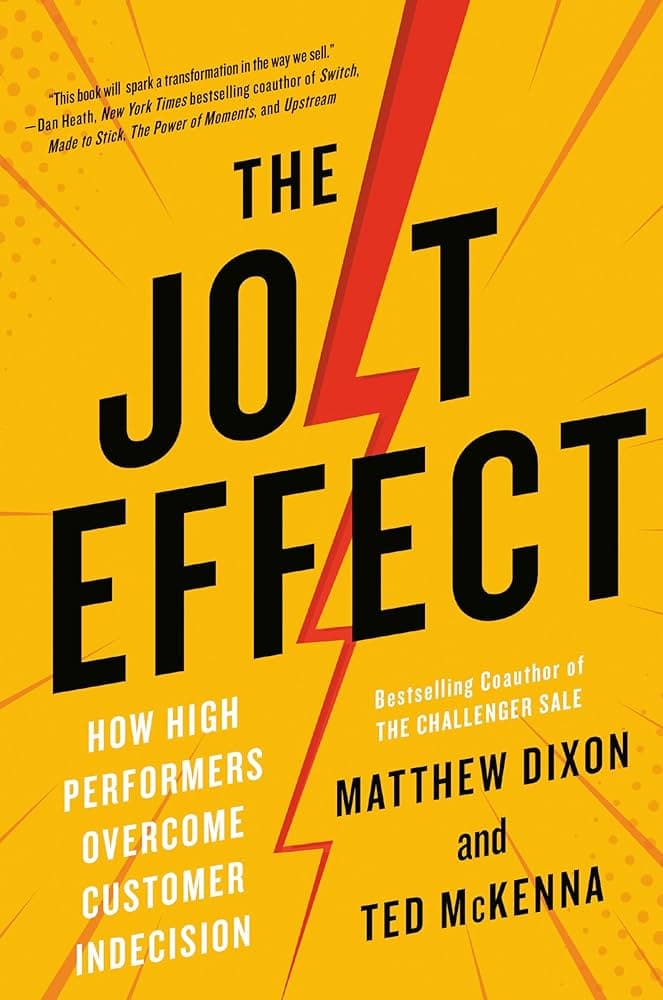
The Jolt Effect: How High Performers Overcome Customer Indecision
Summary of the Book
The Jolt Effect is a transformative guide that dives into how high-performing salespeople effectively tackle customer indecision to close more deals. The book highlights the concept that most sales losses aren't because customers prefer a competitor or see no value in the offering but because they struggle to make decisions.
Key Concepts
Understanding Customer Indecision
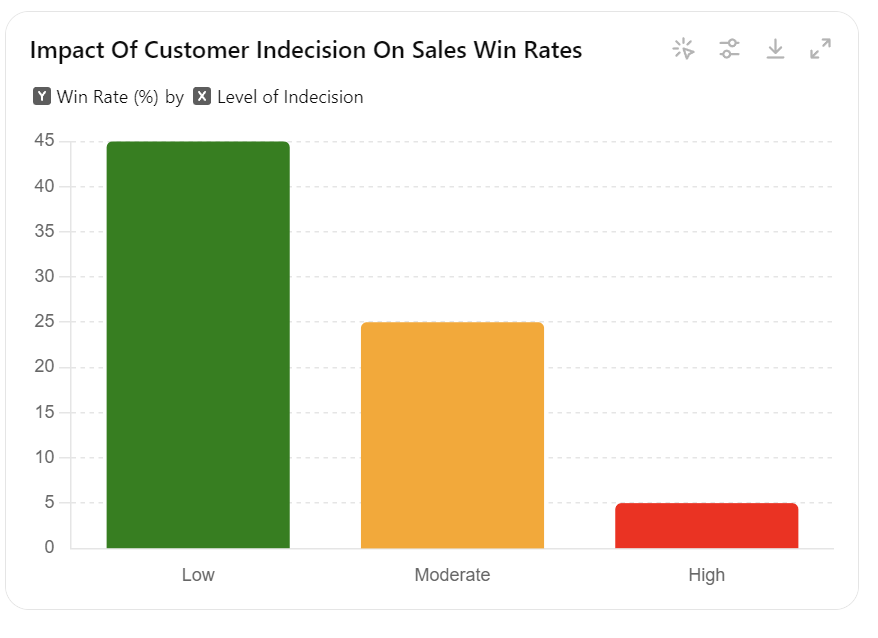
High performers recognize that the primary enemy in sales isn't the competition or even a lack of customer interest—it's the customer's own indecision. This indecision often stems from fear of making the wrong choice, which can be more paralyzing than having no options at all.
The JOLT Methodology
The book introduces the JOLT methodology, a framework designed to help salespeople nudge customers out of indecision:
- J – Judge the indecision: Identify if the customer is truly indecisive or just being polite.
- O – Offer a recommendation: Provide a clear and strong recommendation to guide the customer.
- L – Limit the exploration: Restrict the number of options to avoid overwhelming the customer.
- T – Take risk off the table: Mitigate perceived risks to make the decision easier for the customer.
Applying the JOLT Methodology
Judge the Indecision The first step is accurately assessing whether the customer is stuck in indecision. This involves understanding their hesitations and concerns. High performers use empathetic questioning to uncover these underlying issues.
Offer a Recommendation Instead of bombarding the customer with endless options, high performers offer tailored recommendations. This approach helps simplify the decision-making process and positions the salesperson as a trusted advisor.
Limit the Exploration To avoid decision fatigue, it's crucial to limit the exploration phase. This means presenting a few well-curated options that align with the customer's needs and preferences, rather than an overwhelming array of choices.
Take Risk Off the Table Addressing and mitigating perceived risks can significantly ease the customer's anxiety. High performers do this by providing guarantees, showcasing customer success stories, or offering trial periods.
Applying the JOLT Methodology in Software Consulting
Example 1: Selecting a Technology Stack for a Custom Software Project
Judge the Indecision During the initial meetings, you notice the client is hesitant to choose between several technology stacks. They express concerns about future scalability and maintenance.
Offer a Recommendation After understanding their requirements and business goals, you recommend using a popular and well-supported stack like MERN (MongoDB, Express.js, React, Node.js). You explain how this stack's robust community and scalability align perfectly with their long-term needs.
Limit the Exploration Instead of discussing numerous technology options, you focus on comparing MERN with one other stack, highlighting why MERN is a superior choice based on their specific requirements.
Take Risk Off the Table You offer a proof of concept (PoC) development phase, where you will build a small, but functional, part of their project using the MERN stack. This PoC helps them visualize the benefits and reduces their fear of making the wrong choice.
Example 2: Implementing a CRM System
Judge the Indecision The client is unsure about which CRM system to implement, fearing that a wrong choice could disrupt their sales processes and lead to significant costs.
Offer a Recommendation Based on their existing workflows and integration needs, you recommend Salesforce. You detail how Salesforce's customization capabilities and robust integration options can meet their specific requirements.
Limit the Exploration Instead of presenting all possible CRM solutions, you limit the discussion to Salesforce and one other option, clearly showing why Salesforce is the best fit.
Take Risk Off the Table You suggest starting with a smaller deployment in one department to see how it fits their needs. This trial period helps the client feel more confident about the decision without committing fully upfront.
Example 3: Choosing Between Cloud Providers
Judge the Indecision The client is stuck between choosing AWS, Azure, or Google Cloud. Their primary concern is cost efficiency and ease of use for their team.
Offer a Recommendation After evaluating their use cases and team expertise, you recommend AWS due to its wide range of services and cost-effective pricing models that suit their needs.
Limit the Exploration You compare AWS with only one other cloud provider (e.g., Azure), focusing on specific benefits AWS offers for their particular use cases, such as cost-saving features and ease of integration.
Take Risk Off the Table You propose a phased migration plan, starting with a few low-risk applications. This gradual approach allows the client to test the waters with AWS before fully committing, thereby reducing their anxiety about making a wrong decision.
Types of Status Quo preference
There are three types of status quo preference that salespeople encounter, lack of information, valuation problems and outcome uncertainty:
-
Lack of Information: The customer feels anxious or confused about not having enough information to make an informed decision. They may ask for more demos, reference calls, or conversations with subject matter experts.
-
Valuation Problems: The customer struggles to compare different options or configurations, gets distracted by new features, or expresses confusion about which option to choose.
-
Outcome Uncertainty: The customer is skeptical about the returns they'll see from their purchase, asks for ROI projections, or expresses concern about the risk or investment involved.
The fear of loss
Customers are more likely to make a decision to avoid loss than to realize a gain. This fear of loss drives their decision-making process and can lead to indecision when they perceive a high risk of making the wrong choice.
Inaction inertia definition
Inaction inertia is the tendency to stick with the status quo due to past experiences of passing up better options. This inertia makes it harder for customers to act on objectively good options, leading to indecision and missed opportunities.
Qualify the customer based on decision-making ability
There was an interesting concept here about qualifying customers not just based on their ability to buy but also on their ability to decide. This distinction is crucial because customers who struggle with decision-making are more likely to get stuck in indecision, leading to lost deals.
In our interactions we often find that large organisations have a lot of decision makers and the decision making process can be slow and cumbersome. This is where the ability to decide becomes crucial. Sure they might have the budget to buy, but can they make a decision?
A lot of customers are indecisive and so in that case make a recommendation.
Start small
This is an interesting concept. High performers recommend that customers start small, generate early wins, and then expand from there. This approach helps customers overcome outcome uncertainty by reducing the perceived risk of making a large investment upfront.
Be aware when customers don't show clarity
Show a lot of options upfront and then narrow down
This approach is shown in the famous jelly experiment by Sheena Iyengar and Mark Lepper. They set up a table with 24 different flavors of jelly, and 60% of visitors stopped by to sample one. However, only 3% ended up buying a jar. On another day, they offered only six types of jelly, and 40% sampled one, but 30% ended up buying a jar.
The solution isn’t to eliminate choices altogether for customers; it’s to know when it’s time to shrink the consideration set in order to drive the customer toward a decision.
Note in order to do this the book recommends that you proactiely make recommendations.
The 40-70 rule
Three key skills of high performers
The book highlights three key skills that high-performing salespeople use to limit exploration and guide customers toward a decision:
- Owning the Flow of Information: High performers take control of the conversation and guide customers through the decision-making process, providing valuable insights and recommendations.
- Anticipating Needs and Objections: They proactively address customer concerns and objections, offering rebuttals before the customer even articulates them.
- Practicing Radical Candor: High performers are honest and direct with customers, even when it means challenging their assumptions or decisions. They focus on what's best for the customer, not just making a sale.
And the last quote about it that sums it up really well.
Average win rates
This suprised me:
As a side note, I'm always suprised by how little organisations track their win rates. It's such a crucial metric to understand how well your sales team is performing.
Interupt, get excited and overtalk
These are not words that I would have associated with good salespeople but the book highlights that high performers are quite comfortable interrupting the customer and talking over them when they feel it is important to get the conversation back on track.
Under the same thread, they talk about a concept called cooperative overlapping.